 اللغة العربية
 Български
 Čeština
 Dansk
Dansk Deutsch
 Ελληνικά
 English
 Español
 Suomi
Suomi Français
 हिन्दी
 Magyar
 Italiano
 日本語
日本語 한국어
한국어 Nederlands
 Norsk
Norsk Polski
 Português
 Română
 Русский
 Svenska
 ภาษาไทย
 Türkçe
 中文
中文
Try the Demo Free
Opens in page · No account needed
Lava Balls puts its key mechanic on screen from the first spin: seven circular pots sit permanently below the 5x3 reel grid, each with a live multiplier value - x1 through x1,000, or a Free Spins symbol - that refreshes on every base spin. When a Wild lands and contributes to any winning combination, a Plinko ball drops through a peg board into one of those pots. What that ball hits determines whether the Wild-containing win pays the base symbol value or something considerably larger. It is unusual in slot design for the primary variance driver to be permanently displayed and updating before it triggers - and the effect is a secondary layer of attention on every spin where a Wild could arrive. I ran 1,729 paid spins in the Pragmatic Play provider-direct demo at $2.50 per spin and tracked 14 Free Spins rounds across the full session.
Grid and How Wins Work
Standard 5x3, 243 ways to win. Adjacent reels left to right, no payline selection - any matching combination across all three rows qualifies. Nothing here distinguishes it from half the Pragmatic Play catalog mechanically; the design work is below the grid, not in it. The theme is Greek mythology crossed with a volcanic underworld: Hades and Persephone appear as the top two regular symbols, with arrowhead, boat, and pomegranate filling out the mid-pay tier. Low-pay symbols are the usual card ranks (10 through Ace).
Symbol values from BigWinBoard: card ranks pay 0.2x to 0.8x for five of a kind; pomegranate, arrowhead, and boat pay 1x to 2x for five of a kind; Persephone pays 3x; Hades pays 4x. All at maximum stake. At $2.50 per spin, a Hades five-of-a-kind pays $10 before any multiplier - that reference point establishes what the Wild Plinko mechanic is adding on top.
Visually the game does what Greek mythology / volcanic underworld themes generally do: warm amber palette, stone frame, gold ornament. Standard for the genre. The pots below the grid are the defining visual element and the genuinely unusual design choice: always present, always current, updating with each spin - a secondary information layer that is active before any Wild arrives.
The Wild and Plinko Drop
The Wild is a glowing lava ball that lands on reels 2, 3, and 4 only - never on reels 1 or 5. When it contributes to any paying combination, the game transitions to a full-screen Plinko board: the reel area clears and a peg grid covers the display. One ball drops from the top, working through pins with a physics-style path - each contact shifts direction before the ball settles into one of the seven pots at the base.
The audio is worth a note as a design observation: the base game runs a continuous low rumble that does not escalate with pot values or Wild frequency. The Plinko launch breaks that pattern - a distinct cue fires and each pin click is separate. It functions as a timing signal: the drop has started, the result is coming.
What the ball lands in is the core variance driver. The seven pots hold random multiplier values - x1 through x1,000 - that were already visible on the grid that spin. A Wild contributing to a 2x win gets nothing extra from an x1 pot; the same win structure with an x40 pot pays 80x the bet. The Free Spins pot bypasses the scatter requirement entirely and triggers 12 Free Spins directly - a second bonus path from the same base mechanic.
One note on scope: the Wild substitutes for regular pay symbols only. It does not substitute for the Scatter (golden temple symbol). The two bonus trigger paths - scatter-triggered and Wild-pot-triggered Free Spins - are independent of each other.

Free Spins
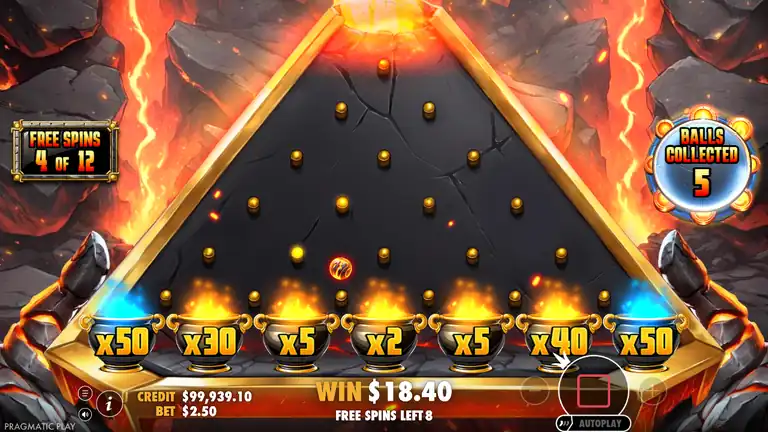
Free Spins trigger two ways: 3 or more scatter (golden temple) symbols anywhere on the grid award 12 base spins, or a Wild ball dropping into the Free Spins pot during a base game Wild win triggers 12 spins immediately. In my 14 Free Spins rounds during the session, all 14 triggered via scatter. The Wild-pot trigger path exists per the rules but did not occur across 1,729 paid spins.
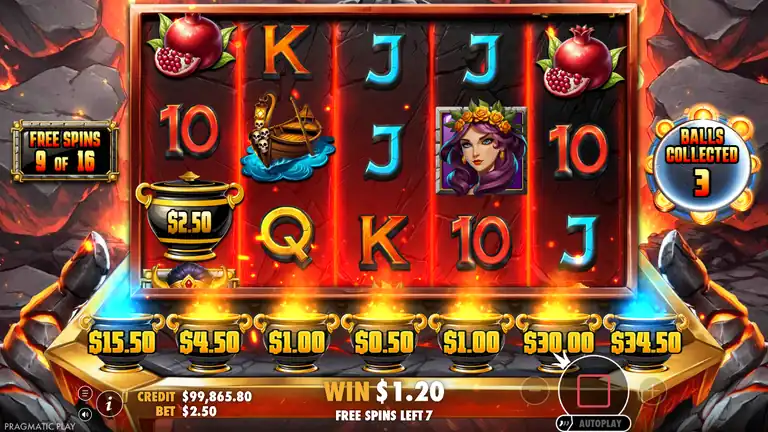
The pot layout changes when Free Spins begin. During the base game the pots hold multipliers; once Free Spins start, they switch to cash prize values ranging from 0.2x to 200x. The leftmost and rightmost pots also auto-increment after each free spin - each adds between 0.2x and 120x to that pot's value during the round, building toward the end-of-round Plinko cascade.
Two additional symbols appear during Free Spins. The Extra Pot Values symbol can land on any reel and adds up to 200x to the pot directly below the reel it occupies. The Ball Drop symbol appears on reel 5 and carries a number indicating how many balls it holds - but the Lava Balls symbol must also land simultaneously on reel 1 for collection to occur. Both must land in the same spin; one without the other contributes nothing to the ball meter.
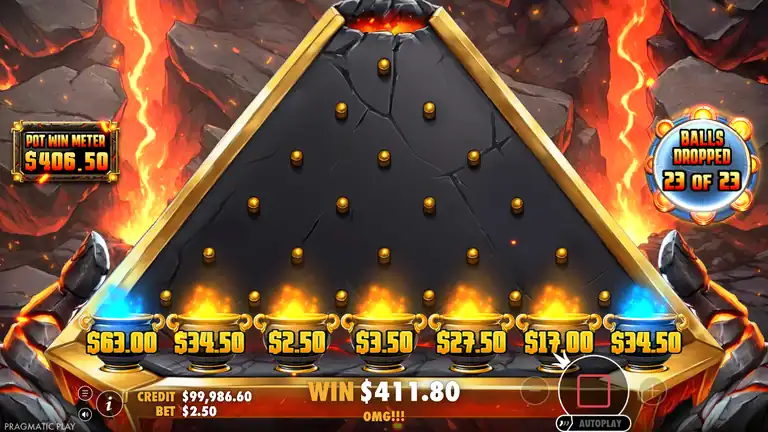
When all Free Spins end, every collected ball drops sequentially through the Plinko board, each awarding the current value of whichever pot it lands in. The side pots (positions 1 and 7) will have auto-incremented throughout the round, making them higher-value targets than they were at the start. More balls collected means more sequential drops - each one a separate result against the current pot lineup.
Retriggers are available via the Additional Free Spins symbol, adding 1 to 5 spins per landing. My 14 rounds ranged from 12 spins (0 retriggers) to 24 spins (5 retriggers). The most extended rounds did not consistently produce higher payouts: Round 5 - the strongest multiplier-driven round at 48.40x - had 0 retriggers and ran exactly 12 spins. The x40 multiplier pot drove that result, not spin count.
Feature Buy
The Feature Buy is available from the base game at all times and costs 100x the total bet per spin - at the minimum $0.25 stake that is $25; at $2.50 per spin it is $250; at the $250 maximum stake it is $25,000. Pragmatic Play states the RTP is the same as the naturally triggered Free Spins - same rate, different entry path.
The cost comparison is worth running. At the stated 1-in-135 natural trigger rate, the expected cost of triggering randomly at $2.50 per spin is 135 x $2.50 = $337.50. The Feature Buy at that stake costs $250 - which is cheaper than the expected random trigger cost. At minimum bet, the expected random trigger cost is 135 x $0.25 = $33.75; the buy costs $25. In both cases the Feature Buy comes in below the expected natural entry cost.
That comparison assumes the trigger rate holds at the stated frequency. This session ran 14 triggers in 1,729 spins - 1 per 123.5 spins, somewhat above the stated 1-in-135. At that observed rate the Feature Buy's cost advantage narrows slightly, but still holds at both bet levels. The Feature Buy's practical value is eliminating the base-game dry stretches between triggers rather than any RTP gain.
Session Data: 1,729 Spins at $2.50
I ran 1,729 paid spins in the Pragmatic Play provider-direct demo at $2.50 per spin. The demo opens through a sequence of intro slides - about eight screens advancing with center clicks, then a close button at the upper right of the screen, then a spacebar before the spin button responded. Once past the intro, the session ran without interruptions or balance resets.
Observed RTP calculation: ($4,322.50 total wagered - $1,077.90 net loss) / $4,322.50 = 75.06%. Expected loss over 1,729 spins at 96.50% RTP is $4,322.50 x 3.5% = $151.29. Actual loss was $1,077.90 - the gap reflects high-volatility behavior at this sample size. The 4,800x ceiling was not reached.
Balance trajectory from six checkpoint snapshots. Peak ($100,398.40) from an early bonus; bonus cluster at spins 759-792 produced the spin-794 recovery.
The balance trajectory followed a recognizable pattern for this volatility level: broadly flat with minor bonus hits through the first 400 spins, a brief push into profit around spin 794 (four bonus triggers landed within 33 spins of each other, between spins 759 and 792), then a steady decline through the second half as bonus frequency dropped. Spins 1,373 through 1,729 - 357 paid spins - produced only two triggers.
Hit rate over the session: 582 wins out of 1,729 spins, or about one in three. The stated frequency is 32.25%; this session ran slightly above that. The Lava Balls hit rate is higher than typical for High-volatility titles because the base game pays small wins consistently - the variance is concentrated in the multiplier layer, not in whether individual spins return anything at all.
The two largest wins of the session came from end-of-round Plinko pot-drops rather than in-spin multipliers: $411.80 (164.72x) around spin 6, which drove the peak balance, and $413.90 (165.56x) on round 12 - the session high (both shown below). Measured by in-spin multiplier, most rounds peaked at x1; the strongest multiplier-driven result was round 5 (spin 324) at 48.40x ($121.01), off an x40 pot in an outer position. Outside those two big ball-collections the majority of rounds returned under 5x - the shape this pot-and-Plinko design produces, where a couple of large collections carry the session.
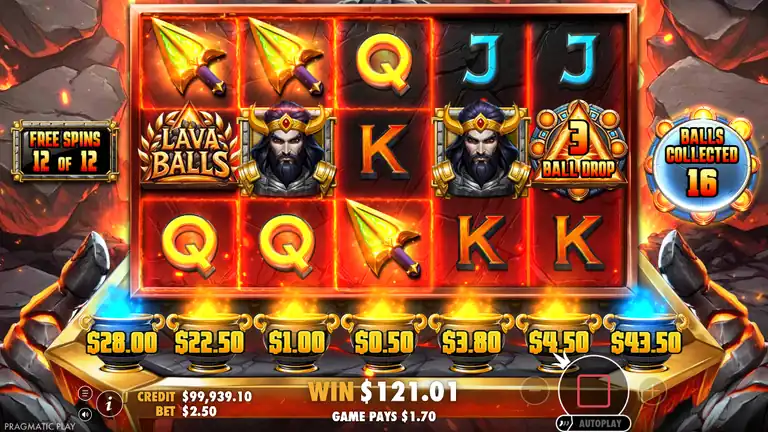
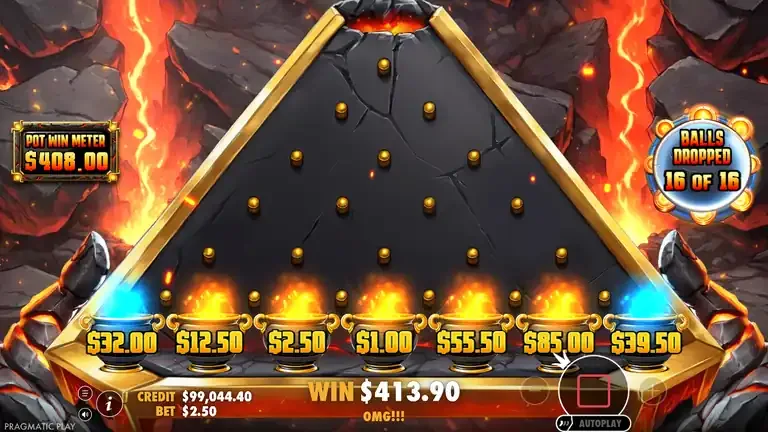
I watched the pot display actively during the Wild-heavy stretches. The seven values update on each spin and the refresh happens during spin resolution - not after. During the bonus cluster at spins 759-792 I found myself reading the pot lineup mid-spin rather than waiting for the reel result, since the current multiplier values shift what any Wild win is worth. The x40 pot that drove round 5 had been sitting in one of the outer positions for a few spins before the Wild finally arrived.
Session Progression




Test limitations: This was a single demo session of 1,729 paid spins completed in full at $2.50 per spin, using virtual credits. The Free Spins trigger via the Wild-ball-in-FS-pot path did not occur in this session - all 14 triggers were scatter-triggered. Ball meter accumulation per individual round was not tracked separately. The 4,800x max win was not reached. One session of this length is not sufficient to characterize long-run return rates on a high-volatility game with a right-tailed distribution.
Pros and Cons
Pros
- RTP 96.50% confirmed on Pragmatic Play's official page - source-attributable, not aggregator-only
- Plinko Wild mechanic active in every Wild-containing base win, not limited to bonus rounds
- Two independent bonus trigger paths: 3+ scatter symbols, or Wild ball landing in FS pot
- Feature Buy at 100x bet with same RTP as natural trigger per Pragmatic Play documentation
- Retriggerable Free Spins via Additional Free Spins symbol - session rounds ranged from 12 to 24
- Hit rate around one in three keeps the base game producing results during dry bonus stretches
Cons
- Three operator-configurable RTP tiers (96.50%, 95.50%, 94.50%) - always verify the applicable rate in-game
- Multiplier layer creates wide round-to-round variance: 7 of 14 session rounds peaked at x1 (under 3x total)
- Ball Drop + Lava Balls paired symbol requirement during Free Spins - both must land in the same spin for collection
- No gamble feature
How Lava Balls Compares
| Feature | Lava Balls (PP) | Pine of Plinko | Gates of Olympus (PP) |
|---|---|---|---|
| Grid | 5x3, 243 ways | Varies | 6x5, clusters |
| Plinko mechanic | Every Wild win (base + bonus) | Bonus phase only | None |
| RTP | 96.50% (default) | 96.55% | 96.50% |
| Max Win | 4,800x | Varies | 15,000x |
| Volatility | High | High | Very High |
| Hit Rate | 32.25% | - | ~8.5% |
| Feature Buy | Yes (100x bet) | Yes | Yes (100x bet) |
Versus Pine of Plinko (Print Studios)
Pine of Plinko uses Plinko as the bonus destination: the slot mechanics get the player into the bonus, and the bonus is a dedicated Plinko board experience. Lava Balls integrates the Plinko drop into every Wild-containing base win, creating a recurring mechanic that appears throughout normal play rather than as a distinct feature phase. Both produce Plinko outcomes. The design tradeoff is frequency versus elaboration: Lava Balls delivers the mechanic on every Wild win in the base game; Pine of Plinko provides a more elaborated Plinko event at the cost of reaching it less often.
Versus Gates of Olympus (Pragmatic Play)
Gates of Olympus is the obvious same-provider reference point - both are high-volatility, both use multiplier mechanics as the primary variance driver, both have a Feature Buy option. The underlying designs are structurally different: Gates of Olympus runs on a 6x5 cluster-pays grid with per-spin multiplier orbs accumulating during cascades; Lava Balls runs 5x3 ways-to-win with a pot system providing Wild win multipliers independent of any cascade. Gates of Olympus has a higher max win ceiling (15,000x vs 4,800x) and a correspondingly lower hit frequency - around 8.5% stated versus 32.25% for Lava Balls. Lava Balls deals base-game wins more regularly and concentrates variance in the multiplier layer; Gates of Olympus concentrates it in both the multiplier and the hit frequency.
Frequently Asked Questions
What is the RTP of Lava Balls?
The default RTP is 96.50%, confirmed on Pragmatic Play's official game page (pragmaticplay.com). Two lower variants exist: 95.50% and 94.50%. These are operator-configurable - the casino version may use any of the three tiers. The in-game rules at the casino in use display the applicable rate. Verify this before placing real-money bets, particularly since the difference between 96.50% and 94.50% represents a house edge of 3.5% versus 5.5%.
How does the Plinko Wild mechanic work?
The Wild (glowing lava ball) lands on reels 2, 3, and 4 only. When it contributes to any winning combination, a Plinko board appears and one ball drops through pegs into one of seven pots below the grid. Each pot holds a random multiplier value (x1 through x1,000) or a Free Spins symbol, updated fresh each spin. A multiplier pot applies that multiplier to all wins containing the Wild. A Free Spins pot triggers 12 Free Spins immediately.
Can I buy the Free Spins feature in Lava Balls?
Yes. The Feature Buy costs 100x the total bet - $25 at minimum bet ($0.25), $250 at a $2.50 stake. Pragmatic Play states the Free Spins RTP is the same whether triggered naturally or purchased. At the stated 1-in-135 natural trigger frequency, the expected cost of triggering randomly at $2.50 is $337.50, which makes the $250 buy mathematically cheaper than the expected random entry cost at that stake.
What is the maximum win in Lava Balls?
The published maximum win is 4,800x the total bet, confirmed by both AboutSlots and BigWinBoard. The probability of reaching this is approximately 1 in 45,045,045 spins per AboutSlots. In this session of 1,729 spins, the maximum single win was 165.56x ($413.90 at $2.50 bet) - consistent with typical high-volatility session variance at this sample size.
How often do Free Spins trigger in Lava Balls?
AboutSlots reports a bonus trigger rate of 1 in 135 spins via the scatter route. This session produced 14 triggers across 1,729 paid spins - 1 per approximately 124 spins, running slightly above the stated frequency. Session trigger rates vary; 1,729 spins is too small a sample to establish a reliable long-run rate. Note also that the Wild-pot trigger path provides a second trigger route independent of scatter count.
Are there multiple RTP variants in Lava Balls?
Yes - three: 96.50% (default), 95.50%, and 94.50%. All three are confirmed by Pragmatic Play's page and cross-referenced via AboutSlots. The operator configures which tier applies at their casino. Some aggregators list only the 96.50% default without noting the lower variants - AboutSlots documents all three. Verify the applicable rate in the in-game rules before placing real-money bets.

Reviewed by Alex Reeves - 1,729 paid spins in the Pragmatic Play provider-direct demo, June 2026. 18+
Where to Play Lava Balls
Lava Balls by Pragmatic Play is available at licensed online casinos that carry the Pragmatic Play catalog. Before depositing, always open the in-game rules and confirm which RTP variant (96.50%, 95.50%, or 94.50%) applies at that operator. The difference between 96.50% and 94.50% is a house edge of 3.5% versus 5.5%.